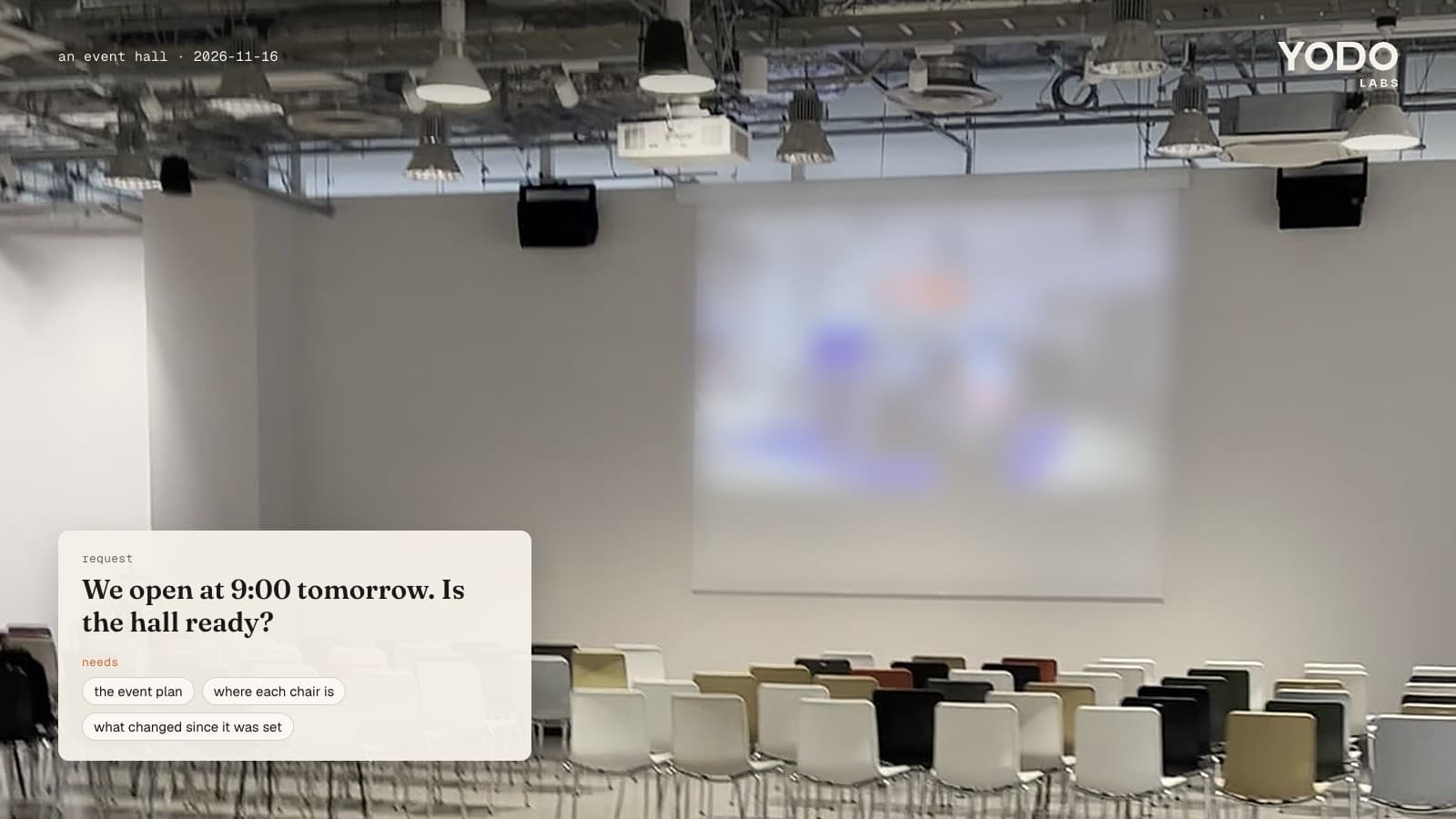
On-site Spatial Intelligence is a site-centric 4D model of one place, shared by the people and robots that work there, so that any of them can ask what each thing is, where it is, what has changed and what is allowed. This essay takes up the words "shared by the people and robots". General models can now drive robots; the essay asks what such a model still needs from the site, and why the site should keep that information for everyone who works there.
Over the past two or three years, general models have changed two fields. In image recognition, one general model has replaced many task-specific ones [1][2]. In software the change went further: writing the code itself has passed to the model [3].
Robots have seen both changes in just over a year (Figure 2): general robot models are starting to replace task-specific ones, and general models are starting to program robots in people's place and to call the robots' skills directly [4][5][6][7][8].
But none of these models knows the site it is sent to work in.
What the model does not know about the site
The model knows what a fire extinguisher is. It does not know that this one is EXT-1F-02, when it was last checked, or what tomorrow's plan says about the room it hangs in. That is site context.
Today the part of this context that reaches a robot is usually its vendor's navigation map, built for that vendor's robots and kept in its format. The map holds geometry; names, plans and history stay in other systems, and the map itself is renewed as the site changes [11]. A robot with one fixed task can work from such a map. But a model that plans tasks nobody wrote in advance needs the rest of the context as well.
Work that depends on the site
Some requests need context that neither a navigation map nor the task app written for the robot carries.
| Request | What answering it needs |
|---|---|
| What is new since last night? | Earlier visits, placed in one frame |
| What moved, and to where? | Positions over time |
| Is the hall set for the 9:00 event? | The event plan, tied to positions |
| Has EXT-1F-02 been checked this month? | Stable identities with their records |
| Robot B picks up where robot A left off | One site record that both robots read |
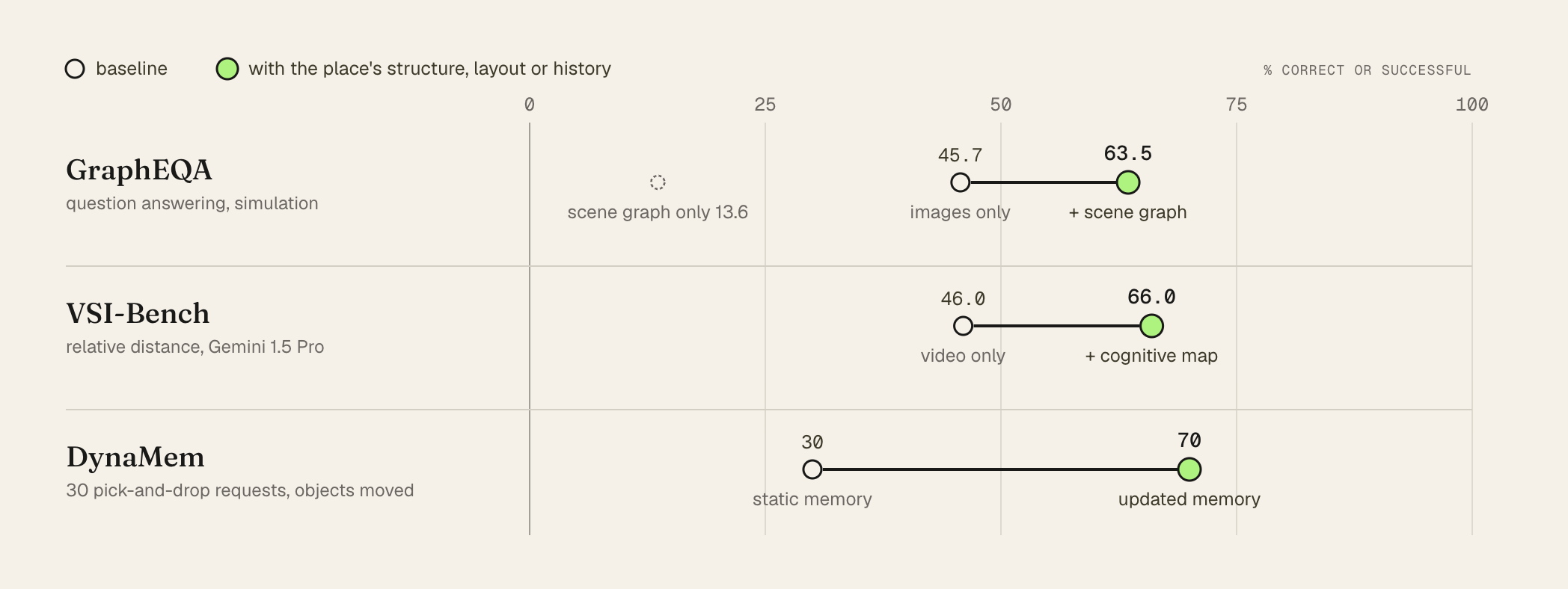
Published experiments point the same way: in embodied question answering and mobile manipulation, results improve when the model is given information about the place (Figure 3) [12][13][14].
The cost of setting up each robot
Today the site engineering behind each robot is largely done again for each vendor and each customer (Figures 4 and 5).
Setup time tends to grow with what a robot is asked to do. A floor scrubber is ready once an operator has driven its route [15]. A warehouse deployment asks more and can take months: Locus Robotics reports five months from project initiation to go-live at a French retailer [16]. A NIST-commissioned study of advanced manufacturing found that the total cost of a robot system, integration included, tends to be three to four times the robot's own price [17].
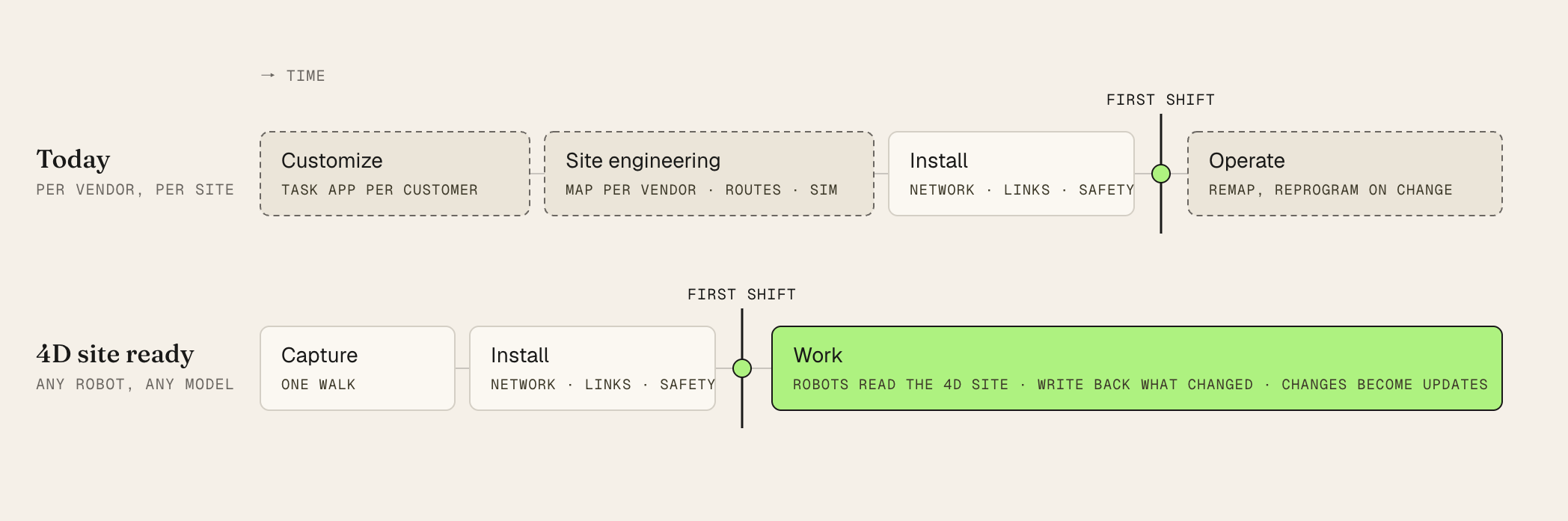
With the task logic in the model and the site's context kept as data, the next robot can start from the site's frame, its identities and its records. Its own map still has to be aligned to that frame through shared reference points, as fleet software does today [18], and its installation checked.
In Japan, the Liberal Democratic Party's June 2026 proposal sets a target of at least 300,000 AI robots across six fields, among them manufacturing, logistics and retail, by the end of fiscal 2030, and calls for training and certifying the system integrators who deploy them [19]. At that scale, site engineering done one project at a time is likely to become the limit.
Why the context belongs to the site
History. Whether a pallet is new, or has gone, depends on earlier visits, and a newly arrived robot made none of them. A site visited every night for two years holds a record that such a robot cannot rebuild.
Shared IDs. Robots from several vendors, the staff app, the booking system and the inspection schedule all refer to the same rack or extinguisher, so its ID has to live where all of them can reach it. Even the geometry stays current more easily when it is shared: in one warehouse whose shelves kept moving, robots stayed localized by streaming their local map changes to a cloud service that merged them into one map [20].
People. Inspectors, cleaners and event staff ask the same questions listed in the table above, and their walks and checks are where most of today's record comes from. A record kept for robots alone would have to be copied for them, and the copies would drift apart.
Neutrality. A robot vendor's site data serves that vendor's robots, and a model company's context serves that company's model. A site with mixed robots needs one layer that serves all of them.
On-site Spatial Intelligence in YODO Asset World
In YODO Asset World, our implementation of On-site Spatial Intelligence [21], the walks staff already make with a camera keep the site's 4D model current, each asset is tied to its row in the site's ledger, and what changed and what has not yet been seen are recorded asset by asset. In a prototype on our own capture, a robot client sends a camera frame, gets its place in the site's frame and reads the record of the asset in front of it (Figure 8).
References
- S. Liu et al. "Grounding DINO: Marrying DINO with Grounded Pre-Training for Open-Set Object Detection." arXiv:2303.05499. Zero-shot transfer to COCO detection. arxiv.org/abs/2303.05499
- Meta AI. "SAM 3: Segment Anything with Concepts." arXiv:2511.16719, 2025. arxiv.org/abs/2511.16719
- C. Jimenez et al. "SWE-bench: Can Language Models Resolve Real-World GitHub Issues?" ICLR, 2024. arxiv.org/abs/2310.06770
- Google DeepMind. "Building the next generation of physical agents with Gemini Robotics-ER 1.5." Google for Developers, 25 September 2025. developers.googleblog.com
- Anthropic. "Project Fetch, phase two." 18 June 2026. anthropic.com/research/project-fetch-phase-two
- Google DeepMind. "Gemini Robotics 2 brings whole-body intelligence to robots." 30 July 2026. deepmind.google
- Stanford TML and Caltech. "HomeBody." Project page, September 2026. tml.stanford.edu/homebody
- NVIDIA GEAR. "GR00T 2." Project page, November 2026. research.nvidia.com/labs/gear/gr00t-2
- Open Robotics Discourse. "ROS MCP Server Release!" 11 September 2025. discourse.openrobotics.org
- Anthropic. "Project Fetch: Can Claude train a robot dog?" 12 November 2025. anthropic.com/research/project-fetch-robot-dog
- Yodo Labs. "What a Robot's Map Forgets." /en/research/onsite-spatial-intelligence-map-lifecycle
- S. Saxena et al. "GraphEQA: Using 3D Semantic Scene Graphs for Real-time Embodied Question Answering." CoRL, 2025. Table 2, simulation ablations. arxiv.org/abs/2412.14480
- J. Yang et al. "Thinking in Space: How Multimodal Large Language Models See, Remember, and Recall Spaces." CVPR, 2025. Table 3a. arxiv.org/abs/2412.14171
- P. Liu et al. "DynaMem: Online Dynamic Spatio-Semantic Memory for Open World Mobile Manipulation." arXiv:2411.04999. Real-world pick-and-drop experiments. arxiv.org/abs/2411.04999
- Brain Corp. "3 key benefits of Brain Corp's Teach & Repeat methodology." 24 March 2021. braincorp.com
- Locus Robotics. Boulanger deployment, 17 April 2025. Project initiation to go-live. locusrobotics.com
- RTI International for NIST. "Economic Analysis of Technology Infrastructure Needs for Advanced Manufacturing: Advanced Robotics and Automation." NIST GCR 16-005, August 2016, Sec. 3. nvlpubs.nist.gov
- Open-RMF. "fleet_adapter_template." Coordinate transformation between the robot's frame and the shared map from matching reference points. github.com/open-rmf/fleet_adapter_template
- Liberal Democratic Party of Japan. 「AIロボティクス社会実装に向けた提言」. 4 June 2026. jimin.jp
- S. Grupp et al. "Cloud-based mapping and localization in dynamic warehouse environments." ROSCon, 2018. research.google
- Yodo Labs. "On-site Spatial Intelligence: Physical AI's Second Data Problem." /en/research/physical-ai-record-layer