The Hazard
A lithium-ion cell in a municipal waste stream is a small, ordinary-looking object with a large and non-linear consequence. It arrives inside a vape, a power bank, a cordless tool, a toy, a pair of headphones, most often inside something else and almost never declared. It survives the household bin. It does not survive compaction in the back of a collection truck, or a grapple in a pit, or a shredder on a sorting line. When it fails, it fails in seconds, it does not need oxygen from outside to keep burning, and the material around it is by definition combustible and deep.
The operator we worked with runs that kind of site, and came to the question through the Tokyo SME Open Innovation Program "Change". The framing they started with was the one the market offers: buy a detector. We ended up somewhere else. What follows is the design that came out of that engagement, before any of it has run on their floor.
Four Windows
The same cell passes four places where something could have seen it, and the four are not interchangeable. They differ in what is physically observable, in what sensor can be mounted there, and in whether anything can still be done about it, which is the part that usually gets left out of the comparison.
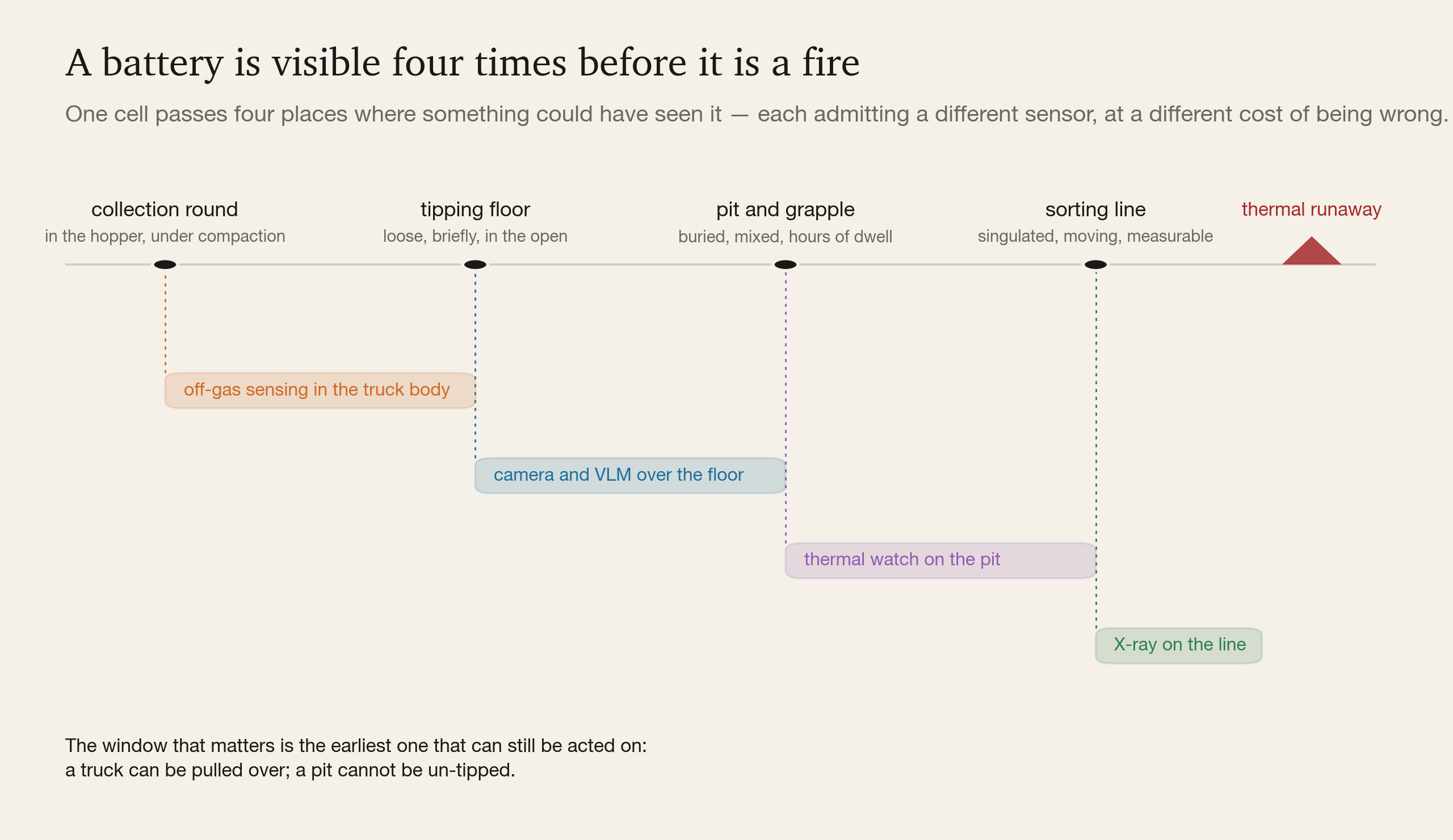
In the truck. The cell is buried in compacted refuse and optically invisible. But a cell that has begun to fail vents electrolyte before it ignites, and metal-oxide gas sensing in the body can pick that up. This is the only window where the response is cheap: a truck can pull over, and one load can be isolated.
On the tipping floor. The load is spread out, loose, in the open, in front of a camera, for a few minutes. A vision-language model can name what it sees here: a power bank, a vape, a drill pack. It reads the top layer, and nothing below it.
In the pit. Hours of dwell, deep material, a grapple that mixes it. Thermal will find a hot spot, but only once it is already hot, which is late. This is the window with the largest consequence and the least room to act.
On the sorting line. The material is singulated and moving past fixed equipment, which is where X-ray belongs: cell geometry is legible inside a closed object, and this is the only modality that sees an intact cell hidden in a housing. It is also the last chance, and it only sees what actually reached the line.
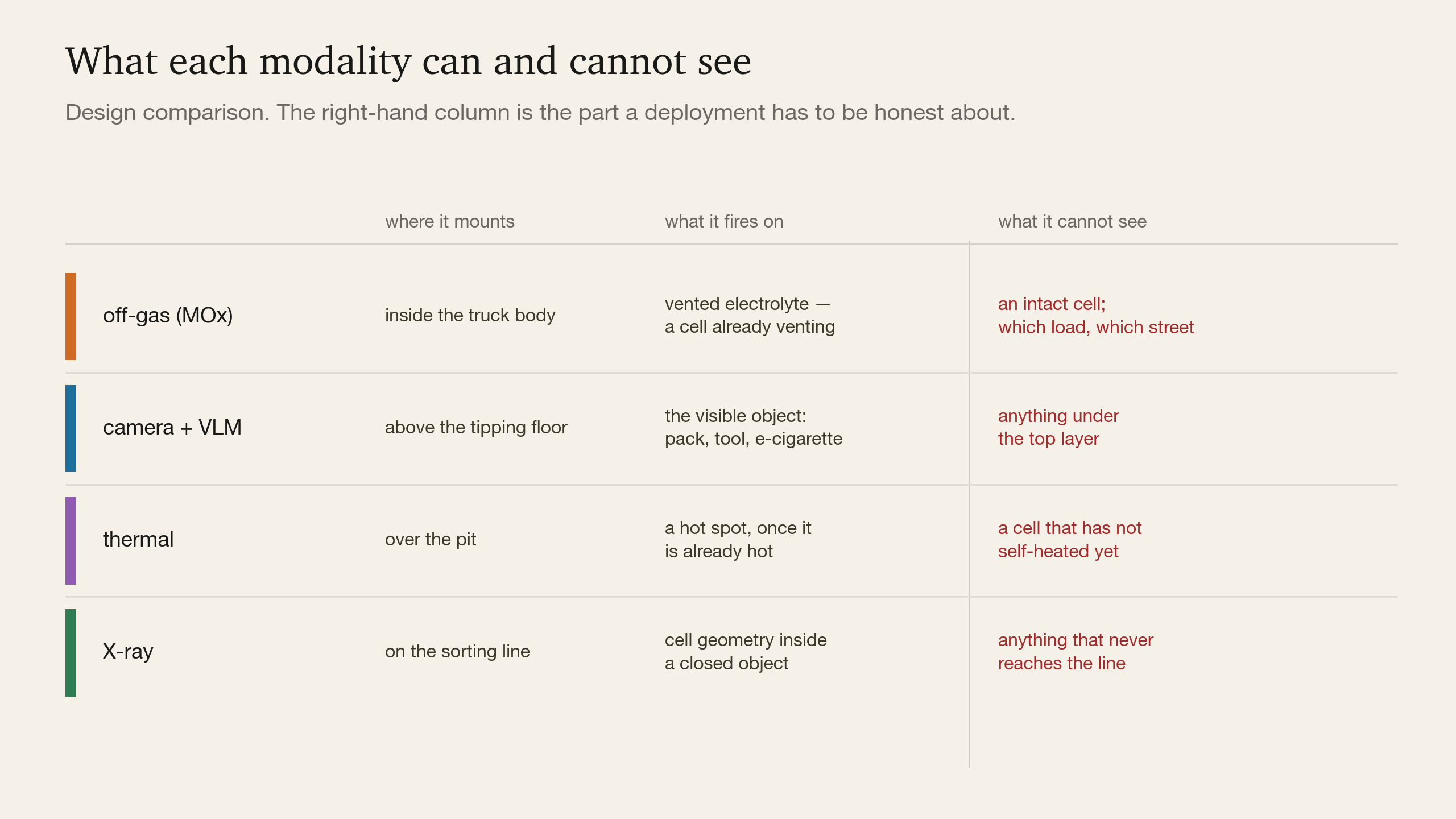
Every modality has a blind region that no amount of tuning removes, and the blind regions do not overlap. Off-gas cannot see an intact cell, the camera cannot see under the top layer, thermal cannot see a cell that has not yet self-heated, and X-ray cannot see what never reached it. No single detector closes this, and no better model will. It is the shape of the problem.
There is a second asymmetry underneath the first. The pit carries the largest consequence and is the one place where sensing arrives too late to help. Whatever can be known about the load in that grapple was mostly knowable upstream, which makes the pit somewhere a record has to reach rather than somewhere to mount another instrument.
The Missing Piece Is a Record
Once the modalities are laid out this way, the gap stops being a detection gap.
Suppose the gas sensor in truck 4 registers a rise at 09:12 on the third street of its round. That is a real observation, and on its own it is close to useless: it has no image, no object, no location finer than "somewhere in this load", and by the time anyone reads it the load has been tipped. Suppose the camera over the tipping floor sees a power bank at 11:04. Also real, and also nearly useless alone, because the floor is cleared every few minutes and the object is already in the pit. Suppose at 11:40 the crane operator is working a corner of the pit that no sensor has observed at all.
Each of those three facts is worth little. Together, bound to the same site and the same clock, they are an instruction: this load, this corner, this hour, treat with caution and pick by hand.
What makes that composition possible is the record.
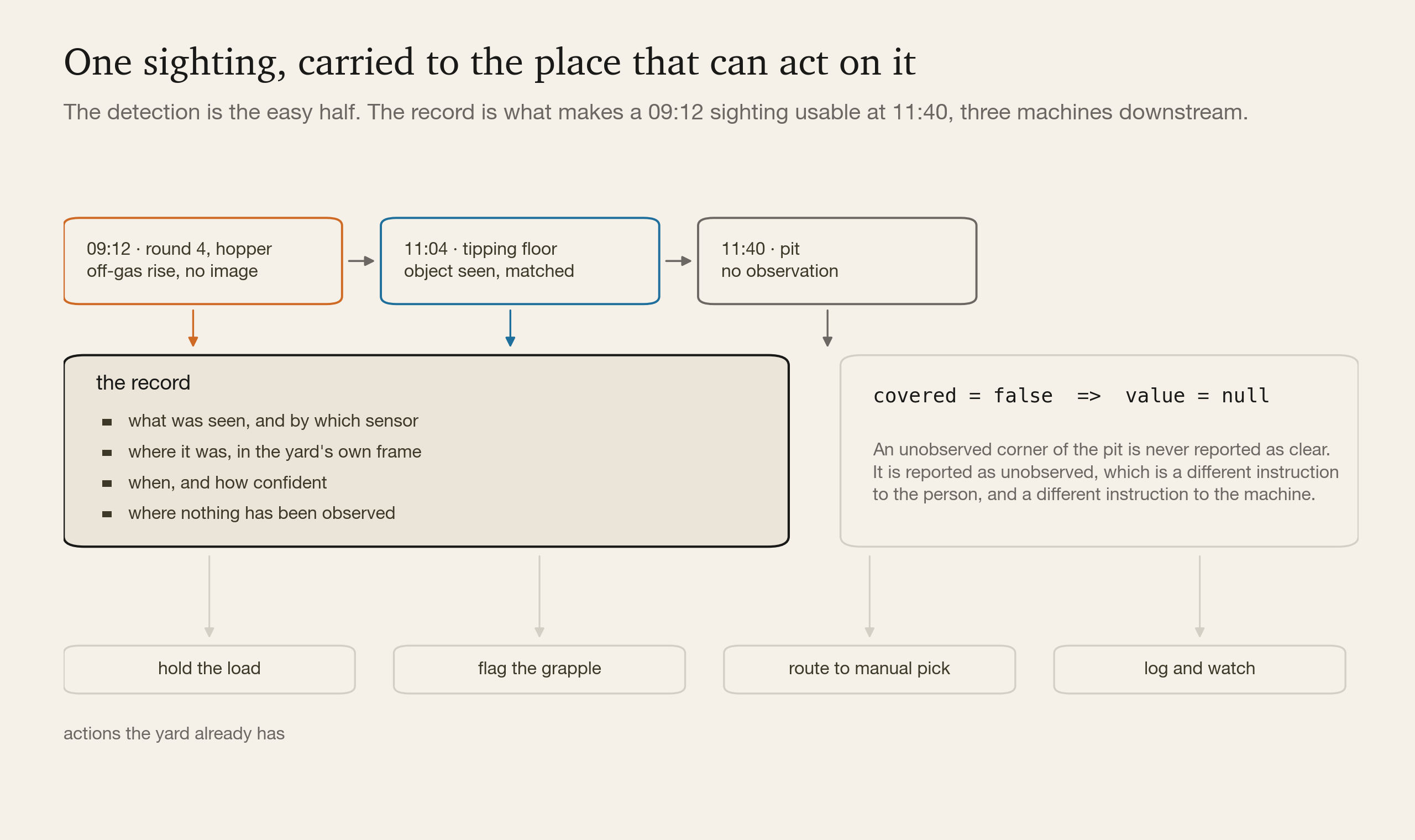
The record has to carry:
- What was seen, and by which sensor. An off-gas rise and a recognised object are different kinds of evidence, and a downstream decision needs to know which it is holding.
- Where, in the yard's own frame. Not "camera 3", but a position in the site that the grapple, the floor crew and the next shift all share.
- When, and how confident. An observation two hours old in a pit that has been mixed twice is not the same claim as one from a minute ago.
- Where nothing has been observed at all.
The last one is what systems drop. A corner of the pit that no sensor has covered is reported as unobserved, never as clear. The invariant is blunt: covered = false ⇒ value = null. It matters for the person, who otherwise reads an absence of alerts as an all-clear. It matters more for a machine, because a machine that treats unsurveyed ground as safe ground will do so confidently and at speed.
What a Deployment Would Look Like
The operator already has the actions. They can hold a load, flag a section to the grapple operator, route material to a manual pick, or log and watch. Nothing in this project proposes new machinery on the floor or a new decision-maker in the yard. The early-warning layer's entire job is to put the right one of those existing actions in front of the right person, early enough that it is still one of the options.
That constrains the build in useful ways:
- Start where the response is cheap. Off-gas in the truck body is the earliest window, and its action, pull over and isolate a load, costs the least. It is also the window with the weakest evidence, so it should escalate rather than alarm.
- Use the cameras that are already there. Tipping-floor and yard cameras exist for safety and operations. Reading them for this costs no new hardware, and hardware on a tipping floor is a liability.
- Report coverage as a first-class number. Not only "we found three today" but "we observed this share of the stream, and these regions not at all". A programme judged only on detections silently optimises toward the easy parts of the site.
Why This One Matters to Us
Yodo's product line rests on one claim: what one camera, one person or one machine has seen should stay available to all the others. Most of our work says that about assets, about a valve, a girder or a machine that is the same object across viewpoints and across years.
A battery in a waste stream is the adversarial version of the same claim. The object is anonymous, it is only ever visible for seconds, it is seen by four sensors that share no language, and the window between the first observation and the consequence is a couple of hours. If a record layer can carry a 09:12 sighting to an 11:40 decision here, it can carry an inspection finding across a five-year maintenance cycle anywhere else. The same record, at opposite ends of the time axis.
Against the four capabilities the product is organised around:
- 01 Localization: ledger-bound reconstruction. There is no object to bind. The cell is anonymous and is never re-identified as an individual, so what the record holds is a position in the site's own frame and nothing more. The finding worth keeping is that the row a sighting binds to is sometimes a region and an interval rather than an object.
- 02 Detection: scene chronology. The same problem with the time axis crushed. In a plant the hard case is a second visit days later with a different device. Here it is the same load four minutes later through a sensor that shares no language with the first, and the earlier state has to survive the grapple mixing it.
- 03 Forecasting: asset intelligence. The direct one, and the capability this case is filed under. The promise it has to honour is that nothing the rounds have not observed is forecast, which is
covered = false ⇒ value = nullwritten the other way round. Here the cost of breaking that promise is a fire, and that is what pushes it out of the preamble and into the schema. The rest of the capability holds too: what comes out is one of the actions the yard already has, with a load and an hour attached, not a risk score. - 04 Grounding. Directly exercised. Every finding carries which sensor, which frame, which threshold and what it did not see, because number and evidence have to arrive together for the operator to be able to disagree.
Three things come back into the product from this. Coverage becomes a field in the record rather than a line in a report, with the invariant enforced where the record is written and the number reported next to the findings. Confidence decays with time and disturbance, because an observation ages, and it ages faster where the material has been moved since; the pit makes that obvious, and a plant rearranged between visits has the same property more slowly. And every finding carries its own evidence, because an operator who cannot check a finding cannot act on one either.
What Is Not Yet Known
Three things would decide whether this works, and none of them is measured.
- How far a venting signature travels inside a compacted, moving truck body, and what the background looks like in a vehicle full of household waste. The earliest window is the one with the least evidence behind it.
- What confidence belongs on a vision-language model naming a power bank on a tipping floor. That number decides whether the window escalates or is ignored.
- The yard's own frame does not exist yet. Truck, floor, pit and line run on separate systems with separate clocks, and binding them is the first piece of engineering.
The failure mode is unusually clear about what honest has to mean. A system that says clear where it means unlooked-at is not a slightly worse system. It is the thing that gets someone hurt.