The task
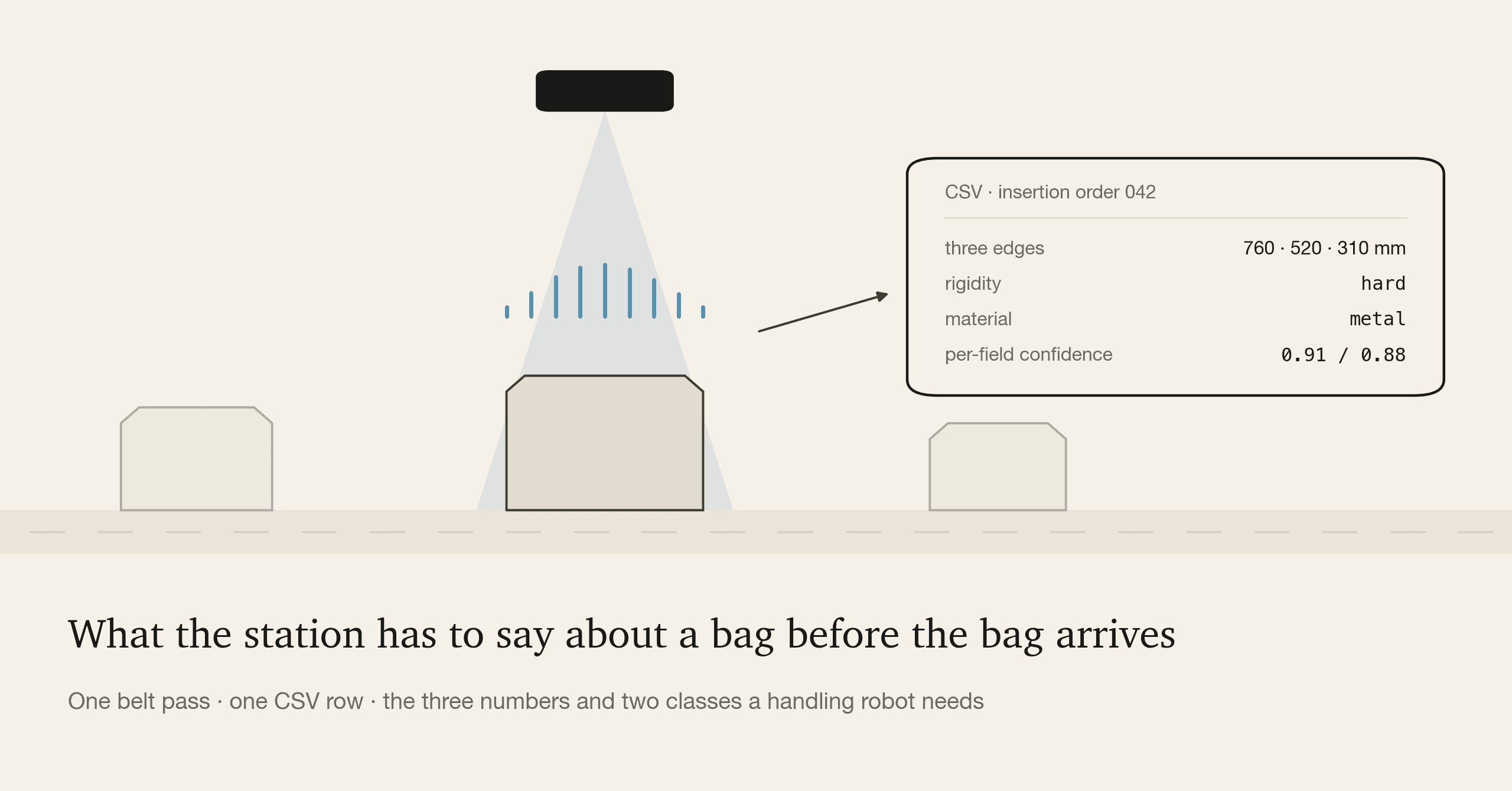
A handling robot at the end of a baggage line has to decide how to take hold of a bag before the bag reaches it. Three edge lengths decide whether it fits the gripper and the container. Rigidity decides whether it can be squeezed at all. Material decides how much friction the grip can count on. None of that is in the airline's systems, because the tag carries a booking rather than a shape.
NEDO's 2026 Challenge puts the gap on a mock baggage line at Saga Airport. The belt runs at 25 m/min and is never stopped. Around eighty pieces go in continuously, at irregular intervals, often at an angle, sometimes two inside the sensing zone at once. For each piece the equipment writes one row: three edges longest to shortest, a rigidity class out of four, a material class out of seven. The rows are matched to the ground truth by insertion order. The tags on the bags are dummies.
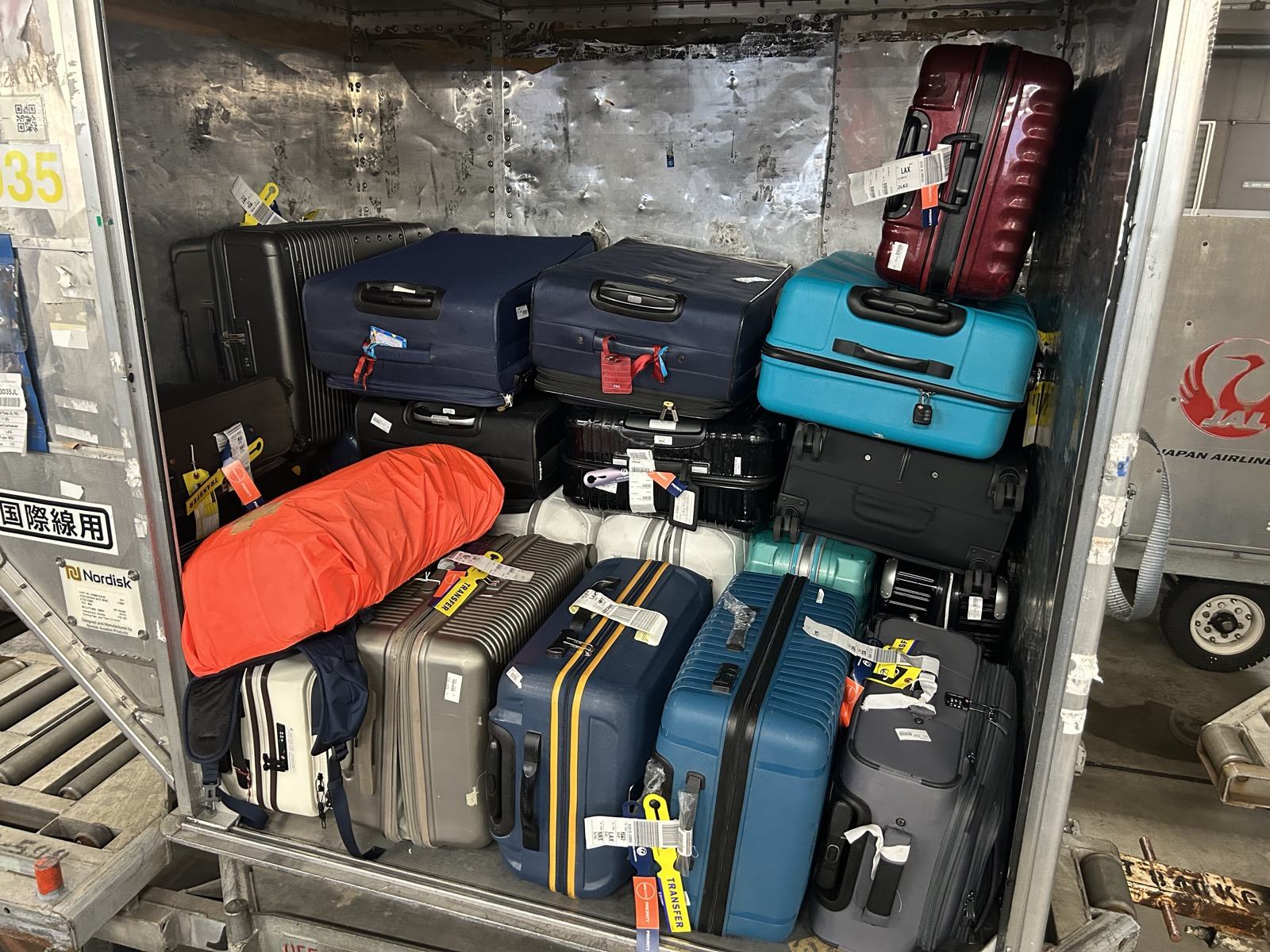
There is no identifier anywhere in the scene, and that single fact decides the shape of the whole system. If the equipment loses count once, merging two bags that touch or dropping one that hides behind another, every row after it is attached to the wrong bag no matter how well it measured.
Binding before measuring
Most perception systems have an identity assumption welded into them somewhere: a barcode, a tracker ID, a fixed camera pose. Ours takes the binding key as a parameter instead. On this belt the key is insertion order, because nothing else exists. Inside a plant, which is what YODO Asset World does, the key is position, because there the equipment is the thing that stays still. The measurement path, the confidence model and the row schema do not change between the two cases. Only the key does.
A moving world seen by a fixed sensor and a static world seen by a moving sensor are the same problem from opposite ends. Writing the key as a parameter is what lets one system serve both.
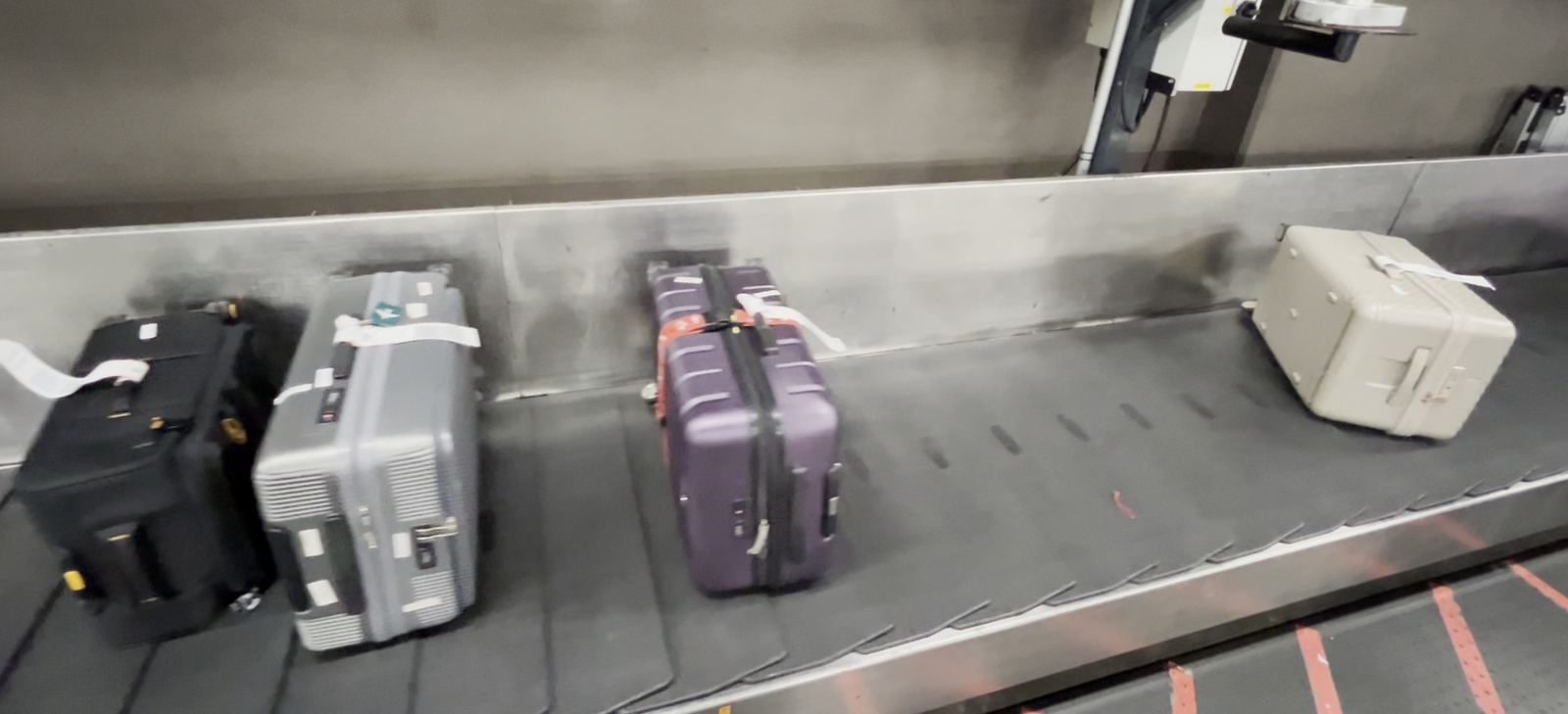
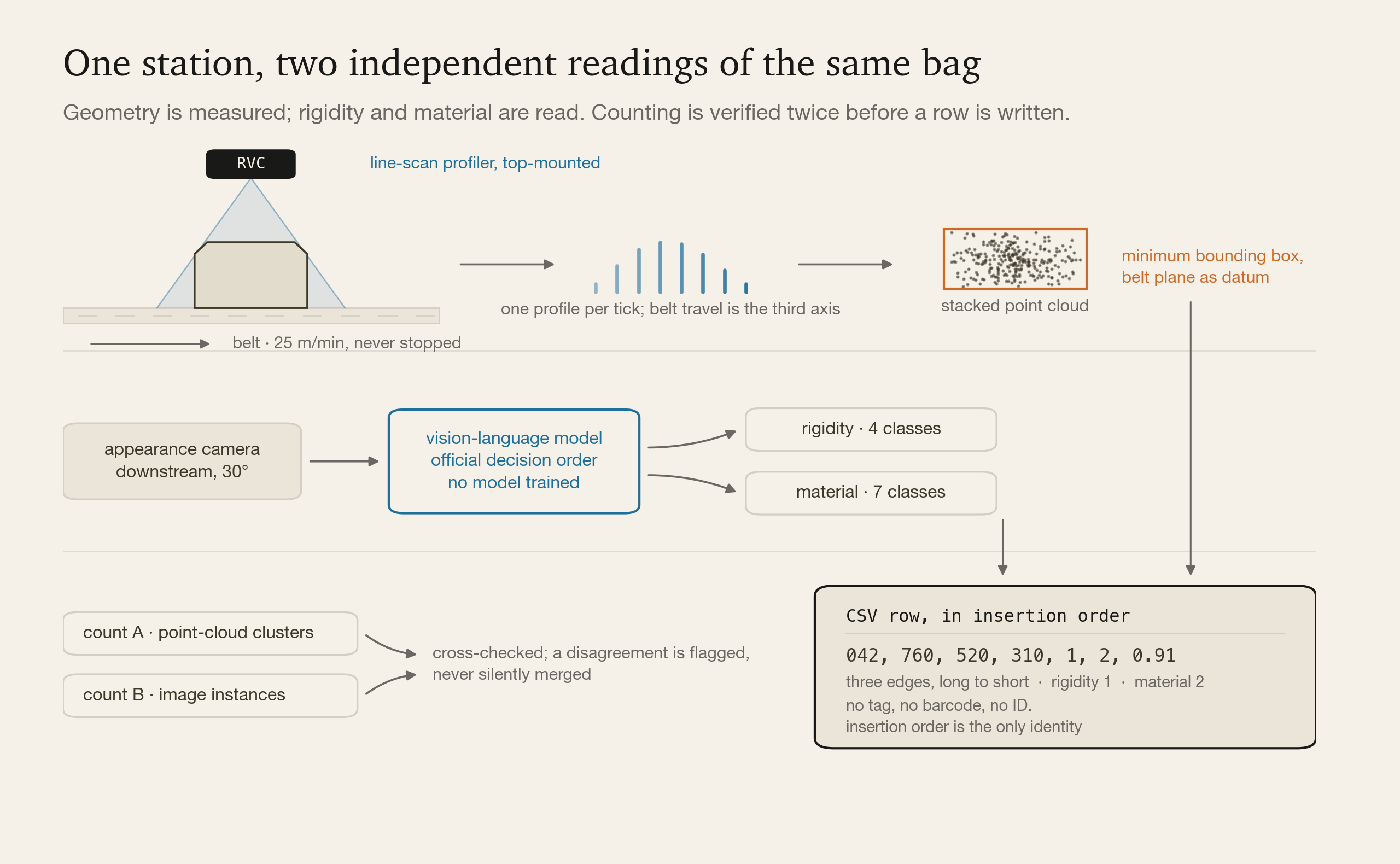
Because the key is order, the count is the identity, so the count gets two independent witnesses. The line-scan profiler returns a count of clusters standing above the belt plane. The appearance camera returns a count of instances. Nothing is written until the two agree.
Where a cluster is anomalously long it is marked as a suspected merge, and the image boundary is used to try to split it. If it cannot be split, the row is flagged rather than merged or dropped. Every raw profile, frame and timestamp goes to disk first, and the CSV is generated afterwards, once the two counts have been reconciled. Across 1,240 bag passes replayed from recorded runs, 6 were flagged for human arbitration and no sequence broke silently.
A flagged row costs points. A silently wrong row costs every row after it. The system is built around that trade.
Other ways of attaching a measurement to an object all assume something this line does not provide.
| Approach | What it binds on | Why it does not work here |
|---|---|---|
| Read the tag | barcode or RFID | the tag carries a booking rather than a shape, and the venue's tags are dummies |
| Trained detector | learned appearance | needs labelled data from this belt, and an unseen bag type means retraining |
| Stop and measure | one object at a time | the belt is never stopped |
| Order, two witnesses | a physical count, cross-checked | failures surface as flagged rows instead of silent ones |
Measure the geometry, read the rest
Geometry is measured. The profiler looks straight down and the belt's own travel supplies the third axis, so a point cloud accumulates as the bag passes. The empty belt is re-fitted as the z = 0 datum in every gap between bags, because the plane drifts and a cold start on a winter morning is enough to move it. A rotating-calipers pass gives the minimum-area rectangle, and the tallest point gives the third edge.
Rigidity and material are read, by a general vision-language model handed the competition's own published decision order. Nothing is trained, fine-tuned or distilled for the task. Three things follow from that. There is no data-collection phase, so the system works on day one at a site it has never seen. A changed class definition is a prompt edit rather than a retraining run, and the competition revised its rigidity adjudication twice while we were building. The read half also improves whenever the model vendor ships, at no cost to us, while the half we own (measurement, counting, binding, confidence) is the half that does not commoditise.
We checked the read half before building any of the runtime, on the competition's published photographs: 240 images for rigidity and 180 for material, hand-annotated against the official class definitions.
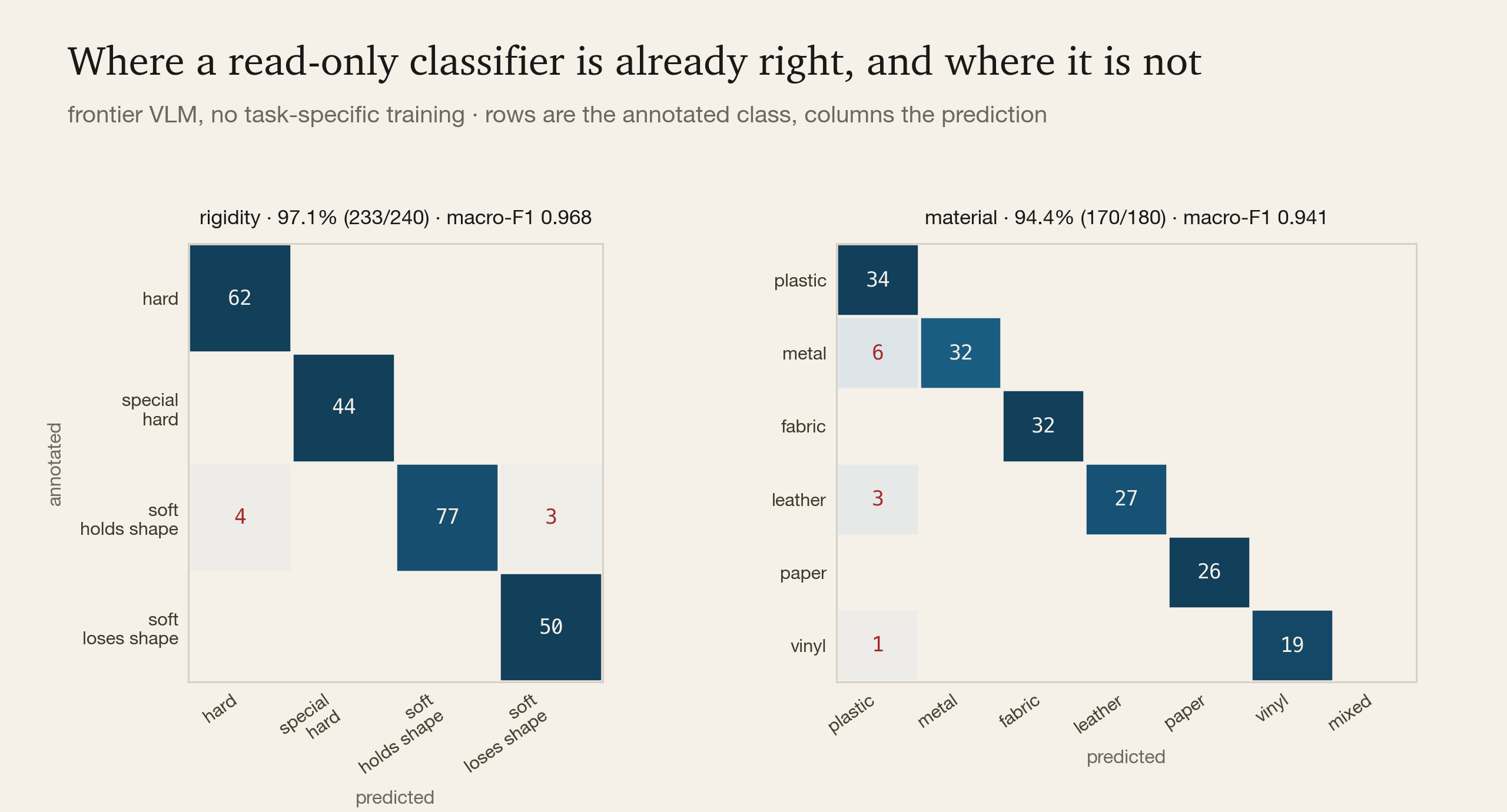
| rigidity (n = 240) | material (n = 180) | |
|---|---|---|
| local 8B, on-premise | 34.6% | 76.5% |
| frontier VLM, read-only | 97.1% | 94.4% |
| macro-F1 | 0.968 | 0.941 |
Three of the four rigidity classes come out clean. All seven errors sit in one class, soft but holding its shape, and they fall into the two classes either side of it, which is the boundary human annotators argue about as well.
The material errors are the more useful result, because they all point the same way. Ten errors among 180 photographs, and every one lands on plastic: six aluminium-frame cases, three leather-faced hard shells, one vinyl-wrapped piece. The model's own justification is consistent about why. It reads the vertical ribbing of an aluminium frame as injection-moulded ribbing, and strong colour pushes the reading further toward plastic.
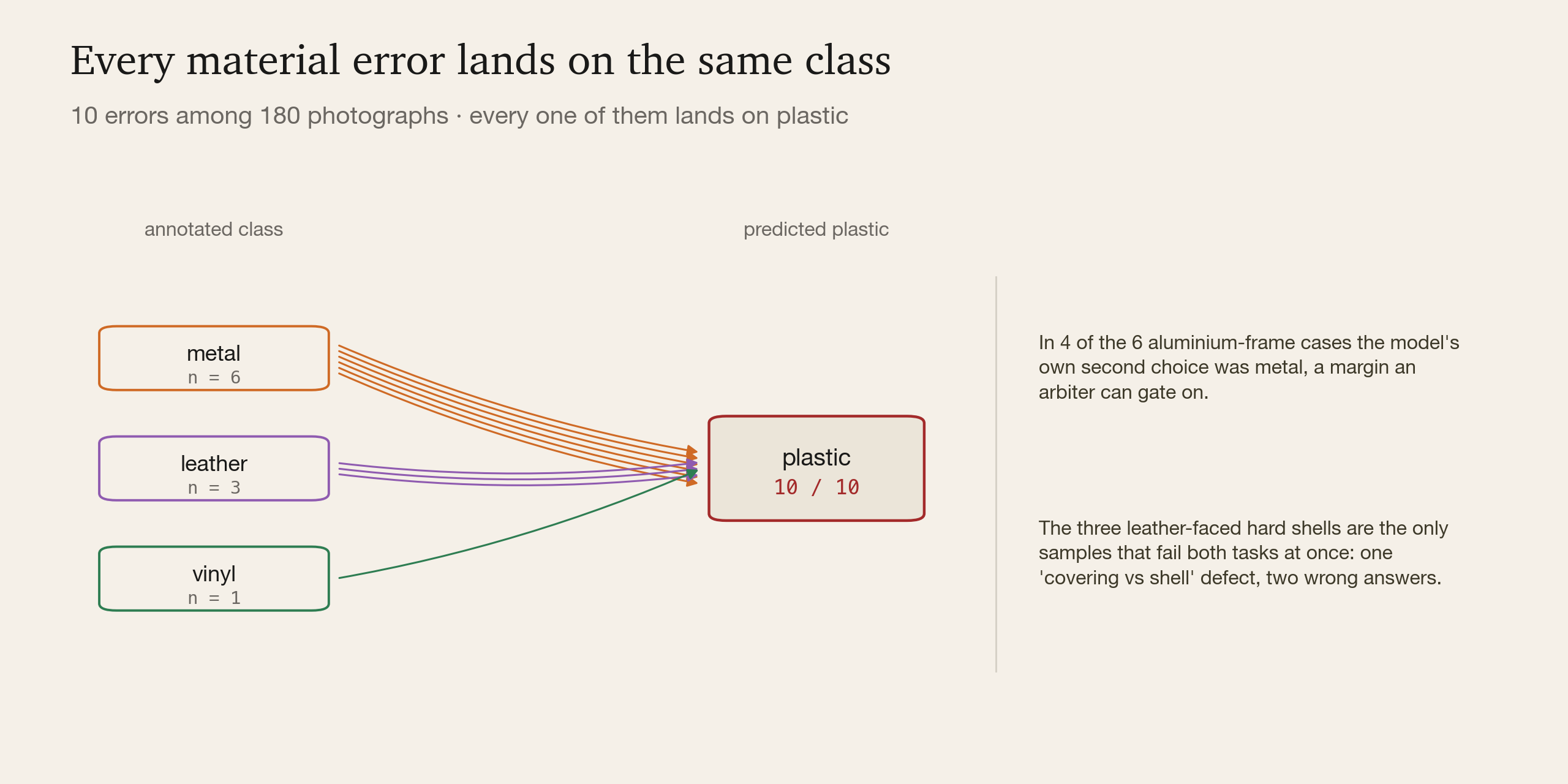
That is what makes the system shippable without training anything. In four of the six aluminium cases the model's second choice was metal, so the information is there and the arbitration is what fails. A margin gate that escalates this one pair, metal against silver or coloured hard plastic, has a well-defined job and a caseload we can count.
The rest of what the station reports: dimension error of 7.4 mm mean absolute per edge on the static rig and 11.2 mm on the moving rehearsal, 210 ms median from leading edge clear to row written with 480 ms at p99, and 2.8% of rows abstaining against a 5% cap. Every field carries a confidence value derived from point coverage, whether the top face approached the edge of the field of view, and the bounding-box fit residual. A row that cannot be measured says so. In a ledger, the difference between a gap and a lie is most of what the ledger is worth.
What the rule tree buys
The competition publishes a decision tree for rigidity: check the type prior first, then whether the structure deforms, then the surface material, then whether there is an internal frame. We ran the end-to-end prompt and five variants of that tree against both models.
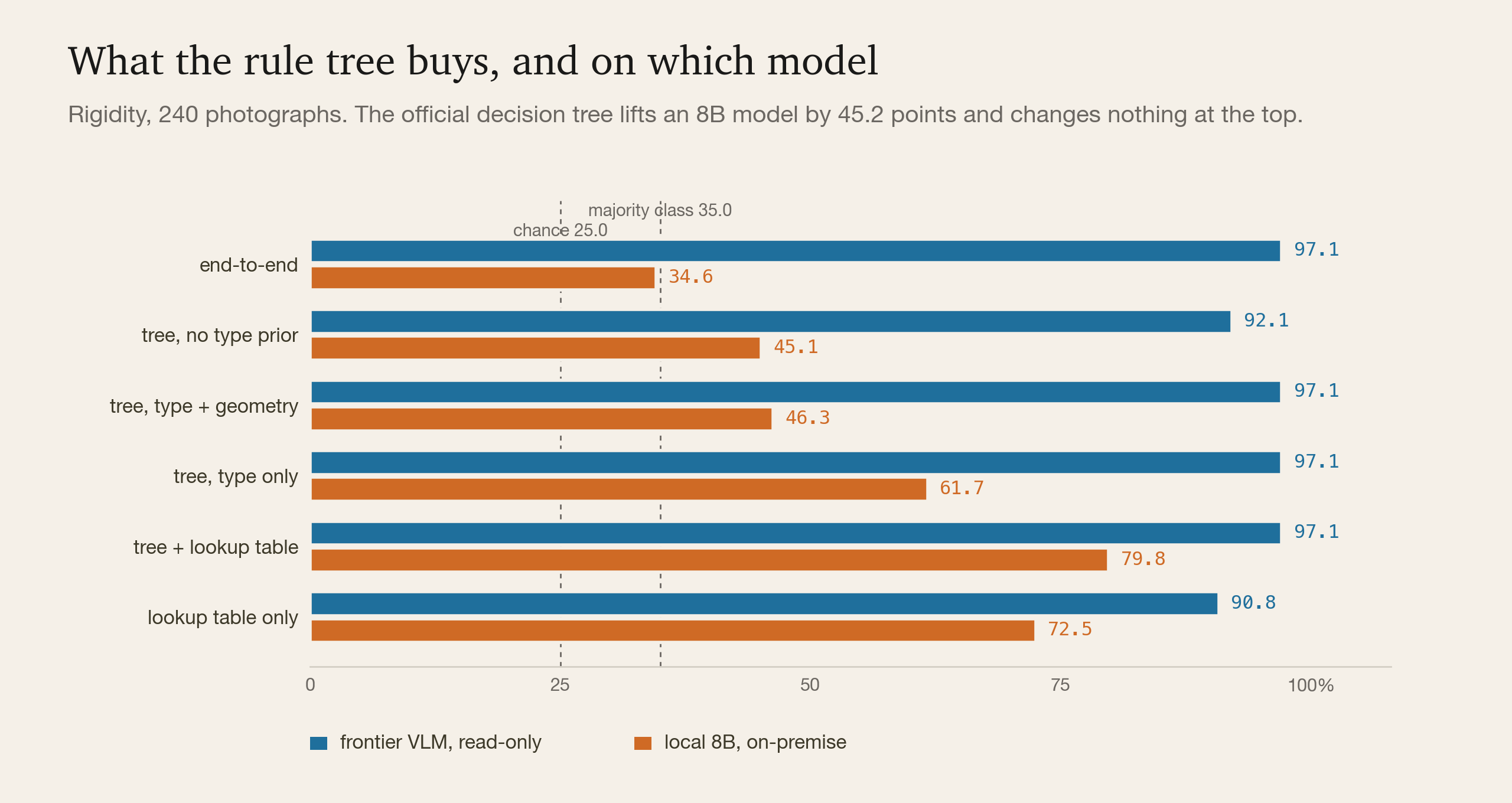
On the 8B model the tree is worth 45.2 points, taking it from 34.6% to 79.8%. On the frontier model the tree and the end-to-end prompt produce identical confusion matrices, agreeing on all 240 samples rather than only scoring the same. The tree rewrote nothing.
So a published decision tree is not really an accuracy mechanism. It is what makes a weak model usable, which makes it a deployment mechanism. The venue has no Wi-Fi, and whether images may leave the site is still open with the secretariat, so what an offline configuration costs is a live question. That curve answers it with a number.
Where this fits YODO Asset World
Take the airport out and what remains is the case Asset World exists for. An observation has to be attached to the right record, by something physical, with no cooperation from the object.
| YODO Asset World, in a plant | This belt | |
|---|---|---|
| The world | static | moving |
| The sensor | moving, one handheld pass | fixed |
| Binding key | position | insertion order |
| The record | persists and accrues | one row, then discarded |
| The reader | person, agent, robot | handling robot |
| What failure looks like | the finding lands on the wrong asset | the row lands on the wrong bag |
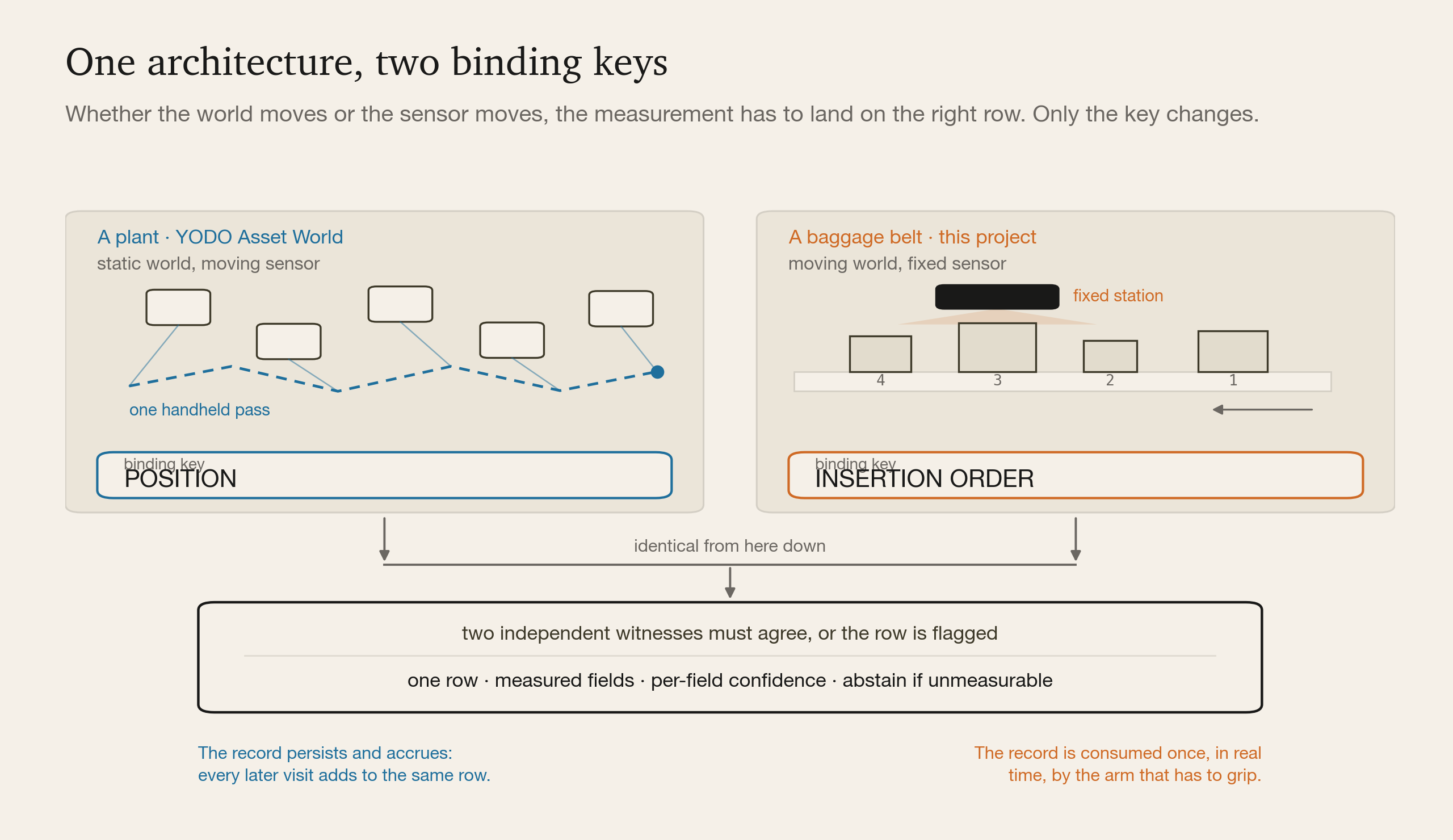
The belt is the hardest binding case we have and the simplest ledger case. It takes away position, the key everything else leans on, and asks whether the rest of the architecture still stands. It does, and what survives the removal is the part worth owning: binding is a physical measurement with two witnesses and an abstention, not an appearance match.
Against the four capabilities on our technology page, 01 Localization is the direct one, since objects come back already attached to a row by a physical quantity. 04 Grounding is direct as well, because number and evidence arrive together and each field carries the coverage, framing and residual it came from, so a downstream machine can decide for itself whether to trust it. 02 Detection is half exercised: the same object is re-identified across two sensors inside one pass, but never on a second visit days later with different equipment. 03 Forecasting is not exercised at all, since the belt has one epoch by construction.
It is also the only engagement where the thing reading our output is a robot. Elsewhere the ledger is read by people through a UI and by agents through an API. Here an arm consumes it in real time and then closes on the object, which makes it the strongest test we have of the machine-facing half of the product.
Four things come back into the product. The binding key becomes a first-class parameter, so a moving-world site and a static-world site run one pipeline. Two-witness reconciliation generalises from counting on a belt to matching on a plant revisit, where a disagreement becomes a flagged row instead of a silent overwrite. The offline profile answers the question every factory asks first. And field-level confidence with abstention goes into the ledger schema, so a record can carry a gap honestly.
Open
The profiler has only been run end to end on a static single cross-section. Dynamic accuracy depends on the belt speed actually being the speed we fitted, and we own no conveyor, so it will be measured on a partner's line.
Absolute accuracy on dark and specular surfaces is unknown. The projector's wavelength is fixed, which leaves exposure, brightness threshold and the confidence filter.
Whether images may be sent off-site is unresolved. Both the cloud path and a fully local fallback are being carried until the secretariat answers.