Client Background
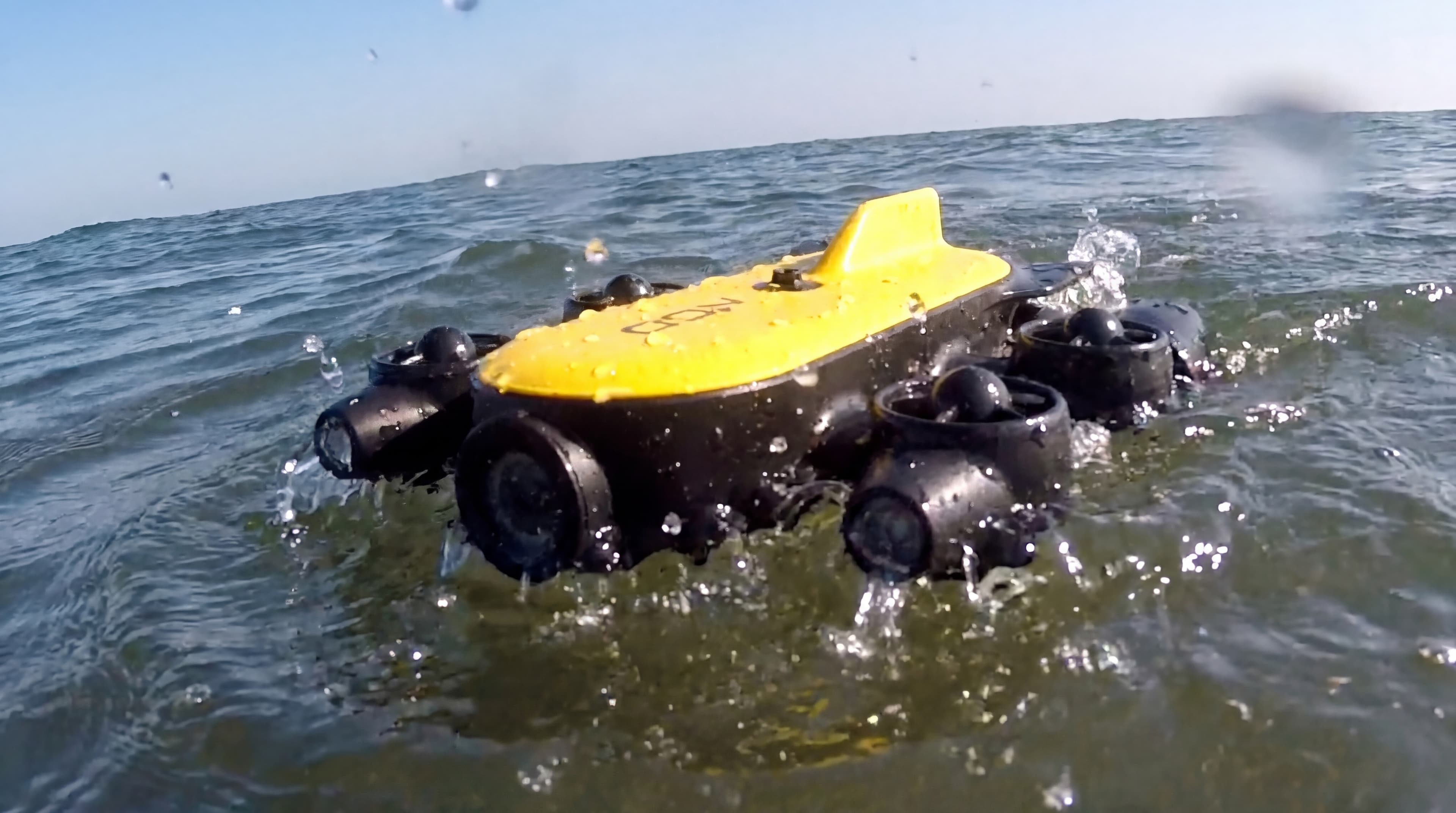
An offshore wind operator running a multi-turbine site in shallow coastal waters. Every turbine's underwater structure (transition piece, monopile, J-tubes, cable protection) is on an annual full-sweep ROV inspection cycle, with event-driven mid-cycle sweeps tied to weather, vessel strikes, or scheduled load surveys. The operator runs an in-house integrity team and an ROV crew, contracts a dive crew for load-survey windows, and feeds every inspection into a CMMS that the maintenance team reads daily.
The operator's full underwater inspection program runs on the Contextual Agentic Vision Platform, across every turbine, every cycle, every contributing data source.
How the Inspection Program Runs
Every new sweep flows through the same path as the last one. There is no per-inspection custom work.
Ingestion. ROV footage from the annual sweeps, dive footage from load-survey windows, and ad-hoc imagery from post-storm or post-strike inspections all come in through the Platform's video pipeline. Frames are de-duplicated, timestamped against the asset register, and tagged with the operator's identifiers (turbine ID, structural component, bolt-pattern position).
The operator's context pack. Their engineering knowledge sits in the Platform and is consulted on every inspection:
- the integrity guidebook — the operator's written triage rules, including conditional rules that fire on combinations of evidence (the rule used in the example below is one of these);
- the maintenance schedule — a rolling 90 days of upcoming activity: ROV sweeps, cleaning windows, load surveys with dive plans;
- the asset register — every turbine, component, and bolt pattern, with construction history and re-certification status;
- the inspection history — prior findings on each surface, so rate-of-change reasoning is possible;
- the cathodic protection log — anode replacement and CP readings, so corrosion findings can be anchored to the protection state at the time of capture.
The operator updates these directly. The Platform reads the live version on every inspection.
Specialist scouts. The Platform's marine/offshore scout library is enabled for this customer: detection and segmentation models for surface corrosion, biofouling, coating breakdown, weld geometry, marine growth coverage, and structural deformation. They output typed records, not prose.
Orchestration and audit. The VLM orchestrator interprets scout outputs in light of the operator's context pack — applies their rules, reads their schedule, compares against their history — and produces structured findings with chains of evidence chips. The judge layer audits the chain before any finding is emitted to the CMMS.
Into the customer's stack. Findings arrive in the CMMS as structured records: severity, recommended actions, deadlines, audit trail. The integrity team triages the queue daily.
The customer keeps the integrity guidebook, schedule, and asset register current, and acts on the queue. The Platform covers everything between frames arriving and findings landing in the CMMS.
A Worked Example: Bracket B-17
A representative finding from a recent cycle. WTG-04, transition-piece bracket B-17, captured on a routine ROV sweep.
The sweep flagged two findings at the same surface:
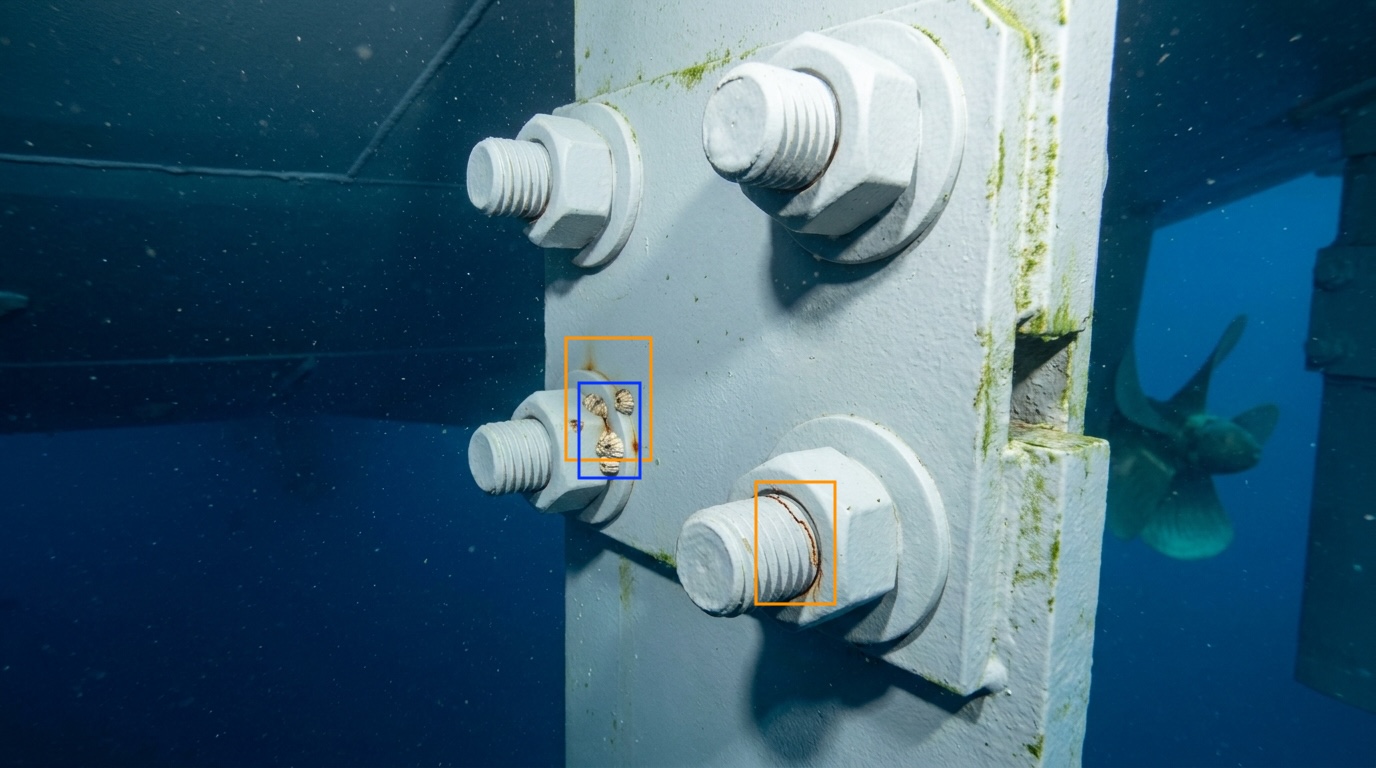
Frame from the routine ROV sweep: surface corrosion (amber) and biofouling (sky) co-located on the load-bearing surface of B-17.
- Surface corrosion around the load-bearing bolt pattern. Iron oxide staining. No immediate dimensional concern.
- Biofouling: a layer of marine growth co-located with the corrosion patch.
On their own, these are two of the most routine findings in any offshore inspection report. The corrosion scout flags surfaces like this every cycle. The biofouling scout flags them more often. Individually, both are low-priority tickets:
- Biofouling alone is a cleaning ticket, queued for the next scheduled cleaning window.
- Surface corrosion alone is a watch-list item, escalated by corrosion rate and structural role.
If the Platform stopped at the scout layer, this would have shipped as two low-priority tickets, and the integrity team would have triaged it that way.
Instead, the Platform cross-referenced the combination against the operator's integrity guidebook. A rule in the guidebook, ingested into the context pack at onboarding, fires only when these two findings co-locate. Paraphrased:
When biofouling co-locates with surface corrosion on a load-bearing surface, the biofouling layer is physically occluding the corrosion behind it. The visible defect should be treated as a lower bound, and the true extent as unknown until the surface is cleaned and re-imaged.
The orchestrator then read the schedule and picked up three relevant markers:
| Marker | Event |
|---|---|
| T+0 | ROV sweep captured this footage |
| T+10 | Biofouling cleaning window: divers and cleaning crew already on site |
| T+16 | Load survey: divers stationed beneath the bracket |
| T+24 | Next routine ROV sweep |
The T+16 marker is what made this urgent. A load survey deliberately stresses the bracket, and the dive plan put humans directly beneath it. The true extent of the corrosion was unknown.
A typical step inside the Platform's reasoning at this point, as the internal trace:
vlm        inspect WTG-04 · TP-bracket B-17 · ROV frame#0506
delegate   → corrosion-scout · biofouling-scout · context-lookup
collect    ← corrosion@bolt-pattern · biofouling co-located
context    integrity-guidebook · combined-evidence rule fires
context    schedule: divers-below in 16d · cleaning in 10d
recommend  hold load-survey · re-shoot in cleaning window · advise dive lead
The Platform pushed four recommended actions into the CMMS for the integrity team's review. None executed automatically; all subject to approval. Each carried its own chain of evidence chips citing the scout outputs, the guidebook rule that fired, and the schedule entries that put a deadline on it:
- Re-shoot after cleaning — within the T+10 window, piggy-backing on the already-scheduled cleaning crew. No new dispatch needed.
- Hold the T+16 load survey pending re-inspection results.
- Advise the dive supervisor to consider an exclusion zone beneath the bracket until the structural finding is resolved.
- Escalate to the cathodic protection / coating review path, independent of the load-survey timing.
The integrity team accepted all four. The load survey was deferred. The cleaning crew re-shot the bracket during their scheduled window. The underlying corrosion was assessed and treated. The load survey was rescheduled once the bracket had been re-certified. Humans-under-bracket exposure while the condition was unresolved was avoided.
What This Pattern Looks Like Across the Program
B-17 is one frame among the many the Platform processes for this customer each cycle. It's worth walking through because it shows how vision and context together change what the operator does.
Either signal alone is a checklist. Corrosion is a watch-list ticket. Biofouling is a cleaning ticket. Both are correct readings of the imagery, both are the kind of output a closed-set classifier produces every cycle, and both undersell the situation.
The combination is a triage change, but only against context. The rule is the operator's own engineering knowledge; the Platform didn't bring it. What the Platform did was fire that rule on the right combination of visual evidence, at the right moment in the schedule.
The schedule made the triage urgent. A re-shoot in a week is routine in isolation. A re-shoot before a planned humans-under-bracket activity becomes a precondition for the load survey to be approved at all. Time-relevant context turned a calendar entry into a gating step in the operator's own approval flow.
This shape — vision evidence fired by an external rule, evaluated against a live schedule — is not specific to B-17. The Platform escalates the same shape recurringly for this customer: corrosion + biofouling, coating breakdown + cathodic protection drop, weld anomaly + load-history flag. Most cycles, most findings flow through as routine. The findings where the combination matters are the ones that change what the operator does next.
Operational State
The operator runs on the Platform across consecutive inspection cycles. The customer keeps the context pack current, the Platform processes each new sweep, findings flow into the CMMS with audit trails, and the integrity team triages on its existing workflow.
The same configuration is available to any operator running underwater asset inspection on the Platform: ROV and dive feeds in through the Platform's ingestion API; the operator's integrity guidebook, schedule, asset register, inspection history, and CP log loaded as live inner context; the marine/offshore specialist scouts enabled; the VLM orchestrator running the operator's rules; the judge layer auditing the chain of evidence chips. The Platform handles the orchestration. The customer owns the rules and the data.