
Client Background
The client is a seed-stage venture capital firm investing in B2B software and deep technology companies. The team of fewer than ten people manages a portfolio of early-stage investments and reviews several hundred inbound deal opportunities per year.
Their existing workflow followed a common pattern: pitch decks arrived by email, a partner performed an initial read, and promising deals were assigned to an analyst for deeper research. The analyst would then spend one to two days manually gathering information across LinkedIn, Crunchbase, Product Hunt, Reddit, job boards, and industry publications before drafting an internal memo.
The firm did not lack judgment or deal flow. It lacked the research bandwidth to apply that judgment consistently across its full pipeline.
Challenge
The core tension was between volume and depth. At seed stage, where companies have limited public track records, thorough evaluation requires piecing together signals from many sources. The firm faced three compounding constraints:
Research was slow and scattered. A single deal required cross-referencing ten or more platforms: LinkedIn for team backgrounds, Product Hunt and Y Combinator for product traction, Reddit and developer forums for market sentiment, job boards for hiring signals, news outlets for funding context. Each platform required separate searches, different interfaces, and manual synthesis. An analyst could realistically complete two to three thorough evaluations per week.
The screening bottleneck caused silent losses. With hundreds of inbound deals and limited research capacity, the firm applied aggressive initial filters. Deals that did not immediately pattern-match to a known thesis were passed without investigation. The team suspected they were missing non-obvious opportunities, but had no way to quantify this or systematically broaden their coverage.
Off-the-shelf AI tools were insufficient for this workflow. The team had experimented with general-purpose LLMs for research assistance. In the configurations available to them at the time, these tools could summarize a document or answer a factual question, but could not reliably orchestrate searches across multiple external platforms in a single pass, and produced unstructured outputs that required substantial reformatting before they could be used in internal processes. The gap was not intelligence but integration and workflow reliability.
Yodo Labs' Solution
Yodo Labs delivered the platform as a six-week pilot engagement structured in three phases: requirements definition and system design (weeks one and two), core pipeline development and integration (weeks three through five), and production hardening with the team using real deal flow (week six).
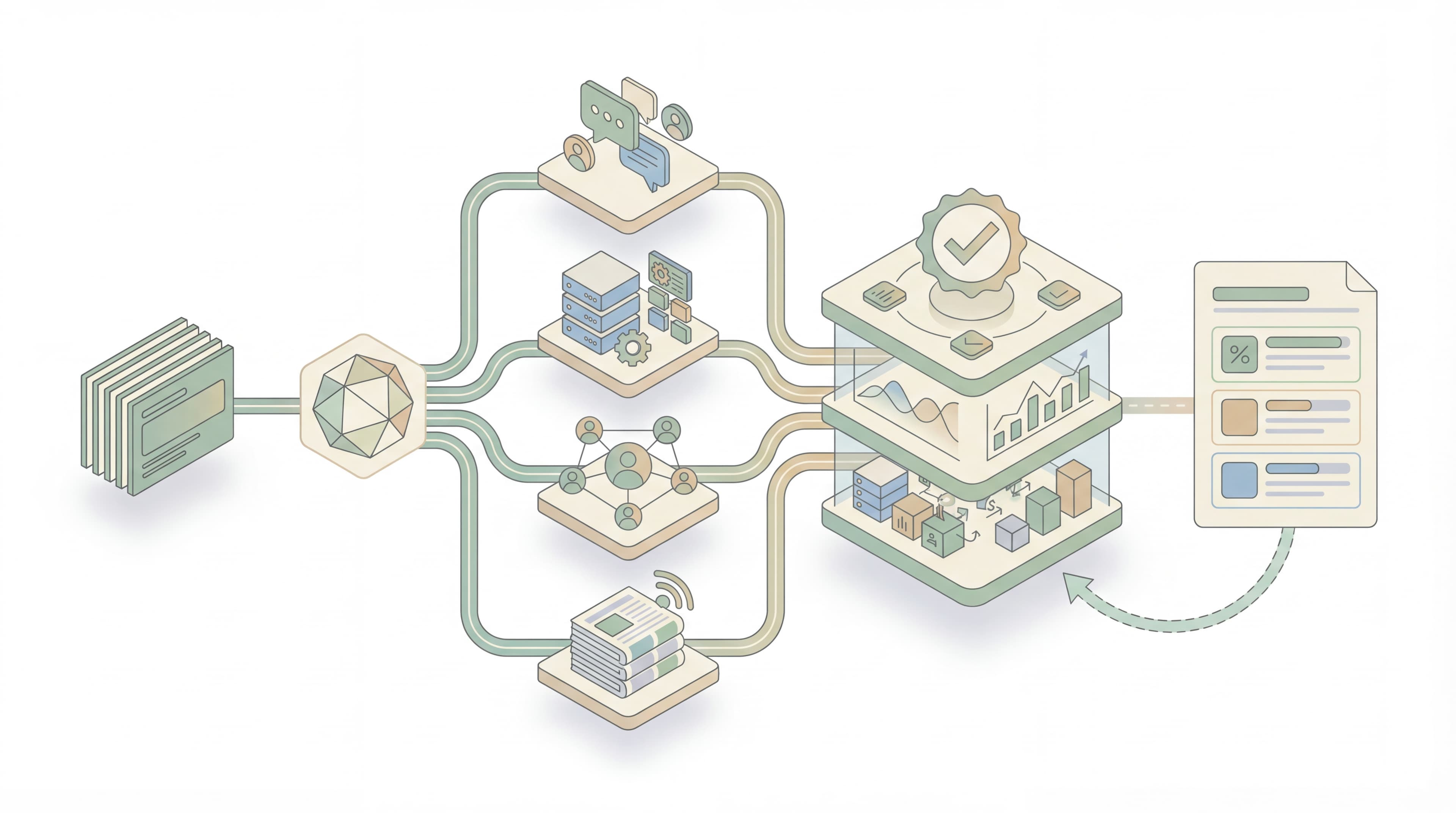
The system processes deals through four stages, each designed as an independent layer that can be updated or extended without affecting the others.

1. Pitch Deck Intake and Structured Extraction
When a pitch deck is uploaded, a document processing pipeline extracts key fields into a standardized deal profile: product description, target market, team composition, business model, traction metrics, competitive positioning, and funding ask. This profile becomes the input specification for all downstream research.
The extraction handles the wide variation in pitch deck formats, from polished investor decks to rough seed-stage slides with minimal structure. Rather than relying on fixed templates, the system uses a language model with structured output constraints to normalize diverse inputs into a consistent schema.
2. Multi-Agent Research Pipeline
The deal profile triggers a coordinated research phase where specialized agents investigate the opportunity across multiple dimensions in parallel:
Market validation agents search Reddit, developer forums, social media, and Q&A platforms for real discussions about the pain points claimed in the pitch. These agents look for evidence that the problem exists, how people currently work around it, and how urgently they want a solution. The output is not a sentiment score but a structured assessment with direct quotes and source links.
Competitive landscape agents scan Product Hunt, Y Combinator, Crunchbase, and industry publications to identify direct and adjacent competitors. For each competitor found, the agents extract positioning, pricing signals, funding history, and differentiation relative to the deal under review.
Team and traction agents examine LinkedIn profiles, hiring activity on job boards, and social media presence to assess the founding team's relevant experience, current hiring momentum, and public engagement with their market.
Funding context agents research recent funding rounds in the same sector and geography, identify comparable companies at similar stages, and surface relevant investor activity. This provides the deal reviewer with a current market map without manual searching.
Each research dimension runs independently with its own concurrency controls and failure handling. If a particular data source is temporarily unavailable, the system completes the remaining research and flags the gap rather than blocking the entire report.
3. Analysis and Validation Layer
Raw research output from multiple agents operating on different data sources can contain contradictions, redundancies, or low-confidence claims. A dedicated analysis layer addresses this through a three-tier agent architecture:
Scout agents (described above) handle raw data collection. Analyst agents receive the scout outputs and synthesize them into coherent assessments per dimension, resolving conflicts and highlighting where evidence is strong versus thin. Judge agents perform a final validation pass across all dimensions, checking for internal consistency, flagging unsupported claims, and assigning confidence indicators to each section of the report.
This layered approach was a deliberate architectural choice. The section below discusses why we chose this pattern over simpler alternatives.
4. Structured Report and Ongoing Monitoring
The final output is a structured due diligence report formatted for the client's existing investment committee process. Each section includes the assessment, the evidence it is based on, source citations, and a confidence indicator. Reports are delivered through a web-based interface where the investment team can review, annotate, and discuss deals collaboratively.
Beyond one-time reports, the platform supports recurring monitoring for deals that enter the active pipeline. Market signals, competitive moves, and hiring changes are tracked on a configurable schedule, with material updates surfaced to the deal owner. This transforms the tool from a point-in-time snapshot into a living intelligence layer across the firm's deal flow.
Why a Multi-Agent Pipeline Over a Single Model
Before building the multi-agent architecture described above, Yodo Labs evaluated a simpler approach: a single agent with broad tool access that would receive the extracted deal profile, call external data sources sequentially, and produce a unified report in one pass. This would be faster to build and easier to maintain. We chose the multi-agent pattern for three reasons specific to this use case.
Heterogeneous data sources require specialized access patterns. Each platform the system queries has different interfaces, rate limits, authentication requirements, and data formats. A Reddit search and a LinkedIn profile lookup are fundamentally different operations. Encapsulating each in a dedicated agent allowed us to optimize access logic, retry behavior, and output parsing per source, rather than routing all platform interactions through a single agent's tool-selection loop. This aligns with the ReAct paradigm of coupling reasoning with action [1], applied here at the level of specialized agents rather than a single generalist.
Research quality benefits from separation of concerns. In our early prototyping, we observed that a single agent tasked with simultaneously gathering data, synthesizing findings, and validating consistency produced noticeably lower-quality outputs than dedicated agents operating within focused roles. By assigning distinct responsibilities to scout, analyst, and judge agents, each agent operates within a focused context window and a clear objective. The judge agent in particular serves as a quality gate that would not exist in a single-pass architecture: it catches inconsistencies between dimensions that no individual agent can detect from its own partial view. The multi-agent conversation pattern described in AutoGen [2] informed our approach to structuring these inter-agent interactions.
Failure isolation enables graceful degradation. In a single-agent architecture, a timeout or error from one data source can stall the agent's reasoning loop and delay or fail the entire research process. The multi-agent pattern provides natural failure boundaries. If the Product Hunt agent encounters an issue, competitive research from other sources still completes in parallel, and the report is delivered with an explicit gap notation rather than no report at all. During the pilot, this property proved important: at least one external source experienced intermittent availability on any given day, and the system handled it without manual intervention.
The tradeoff is increased system complexity and higher end-to-end latency compared to a single-agent approach. For this use case, the improved reliability and output quality justified that cost. A complete deal research pipeline executes in approximately ten to fifteen minutes, which is well within the acceptable window for a workflow that previously took a full working day.
Results
The platform was delivered as a working system at the end of the six-week pilot, processing real deal flow from the client's pipeline:
- Research time compression: Initial screening research, previously requiring approximately eight analyst-hours per deal, was reduced to under fifteen minutes of automated processing plus a brief analyst review of the structured report.
- Expanded deal coverage: With the same team, the firm evaluated roughly three times more deals at a meaningful depth during the pilot period compared to their historical pace.
- Non-obvious deals surfaced: Three deals that would have been passed at the initial screening stage (due to unfamiliar market or non-standard pitch format) were flagged by the system's market validation agents as having strong underlying demand signals. These entered deeper evaluation.
- Analyst role elevation: Analysts spent less time on repetitive search-and-summarize tasks and more time on founder conversations, reference calls, and strategic assessment, the work that benefits most from human judgment.
- Production adoption: Following the pilot, the client converted the engagement to an ongoing production contract. The platform is now integrated into their standard deal review process.
References
Yao, S. et al., ReAct: Synergizing Reasoning and Acting in Language Models. Princeton / Google Research. arxiv.org/abs/2210.03629
Wu, Q. et al., AutoGen: Enabling Next-Gen LLM Applications via Multi-Agent Conversation. Microsoft Research. arxiv.org/abs/2308.08155